
The 19th century was a boom era for discoveries in the astronomical universe. Mesmerized by the heavenly bodies that inhabited the night sky, early astronomers could only wonder just how vast the stars stretched, leading to many advancements in science and technology for space exploration. This was a time that saw astronomy applying developments in mathematics, physics, chemistry, and geology to understand the make-up of these cosmic lights and the origins of the universe. Neptune was discovered in 1846. The search for a "fifth" planet between Mars and Jupiter resulted in the realization that the void of hundreds of thousands of faint and tiny bodies was actually the halo expanse of the asteroid belt.
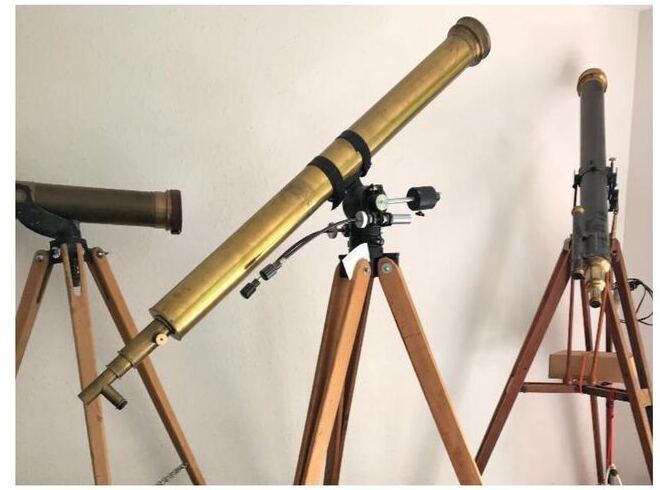
Imagine being able to own a piece of history that has seen over a century of stars. From the Peter Abrahams estate, we have the rare opportunity to offer a fine 1880s refracting telescope manufactured by Alvan Clark & Sons of Cambridgeport, MA, one of the most important American optics firms of the time.
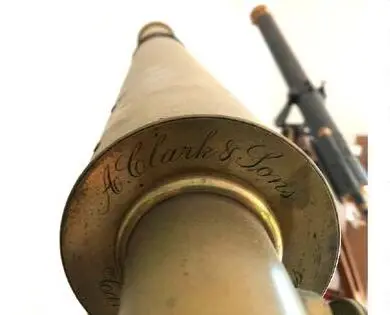
Alvan Clark was born into a whaling family in Ashfield, Massachusetts in 1804, and began his career as a talented portrait painter and engraver. Clark moved into the telescope business at the age of 40, and founded Alvan Clark and Sons with his two sons, George Bassett and Alvan Graham. Together, they built numerous large refractor telescopes for observatories, and smaller ones for personal use, like the one we have here. Five of their refractor telescopes were the largest in the world when they were produced, and four are still in use today. The last, the 40-inch refractor built for the Yerkes Observatory in Wisconsin, remains the largest successful refractor telescope of all time. Clark's son Alvan Graham, when testing the 18½-inch refractor built for the Dearborn Observatory in 1862, discovered Sirius B, the "Pup," or faint companion to Sirius, the brightest star in the night sky.
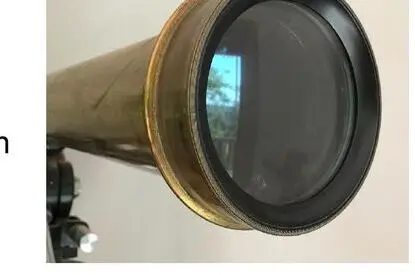
This particular Clark Telescope is circa 1880, and features a 4-inch refractor, 4-inch objective lens, 52-inch tube, and a 63-inch OA. The telescope sits on a well-made, modern, home-crafted stand. It also features a finder scope and modern accessories in a box.
Shop the Peter Abrahams estate collection of astronomical devices and scientific equipment — SHOP NOW